
Commodity Market Research
Explore our research into commodity market behavior using advanced analytical techniques.

At Morgan Group
Commodity Market Coverage
We model a basket of 40 commodities and markets. These include public markets (e.g., SPX), metals and mining (e.g., gold), food and agriculture (e.g., sugar), and energy (e.g., oil).
Research and Risk Monitoring
We monitor total exposure, correlation, and expected drawdown. We have over 1 year of experience researching and validating these Commodities.
Markets and Instruments
These commodities are modeled in both the futures market and the US stock market through equivalent ETFs.
Commodity Trading Models
We run 2 separate commodity trading models:
Short-Term Commodity Trading
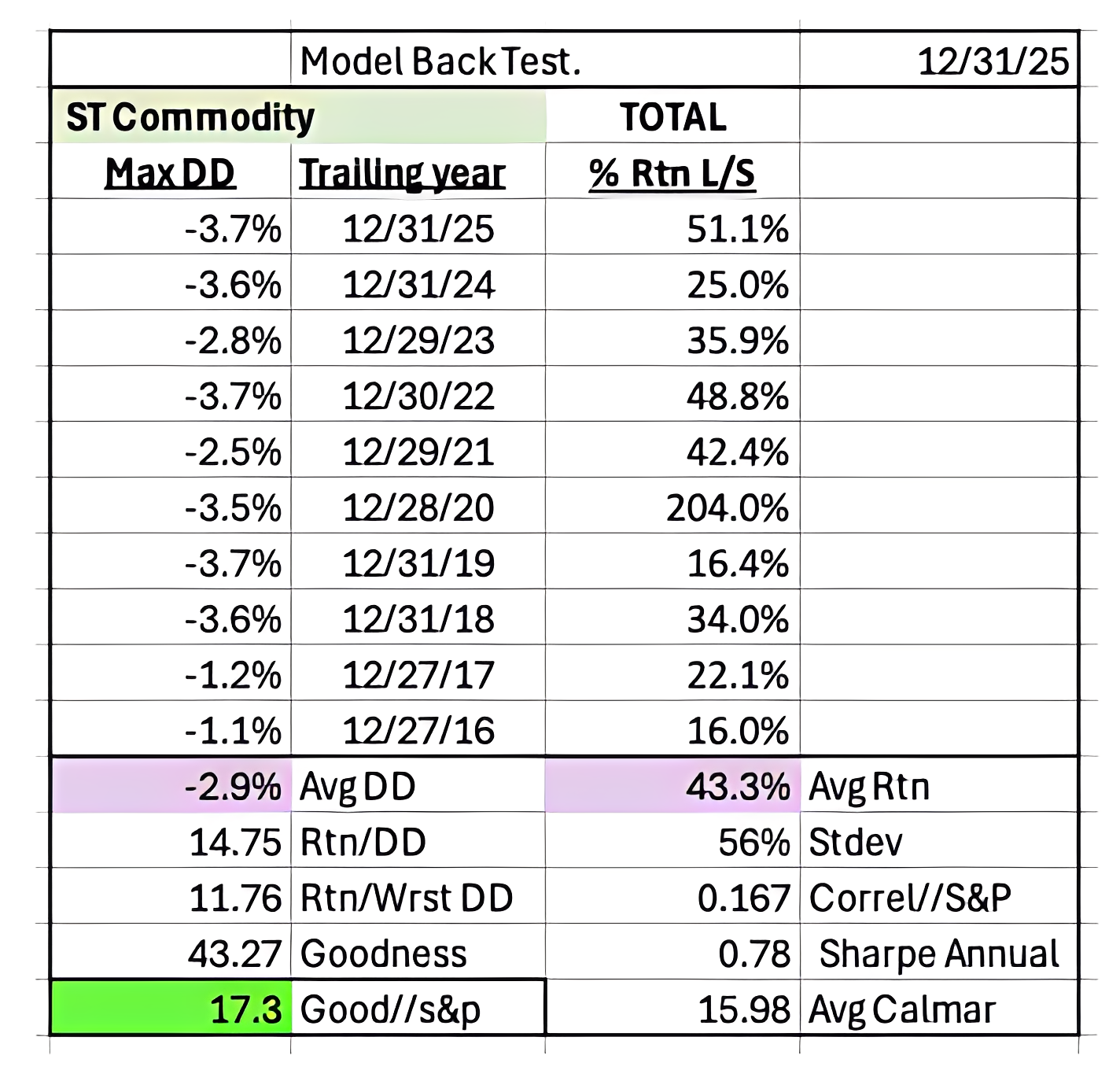
We have a short-term model, with an average hold of 2 days, and limited capacity. Our modeling and back-testing indicate that this system can be traded with an estimated risk-adjusted return of >10x holding the S&P and an average correlation to the S&P of 0.17 for the 10-year period shown.
Short-Term Commodity Model Results
Hypothetical performance results have many inherent limitations. No representation is being made that any account will or is likely to achieve profits or losses similar to those shown. In fact, there are frequently sharp differences between hypothetical performance results and the actual results subsequently achieved by any particular trading program.
Mid-Term Commodity Trading
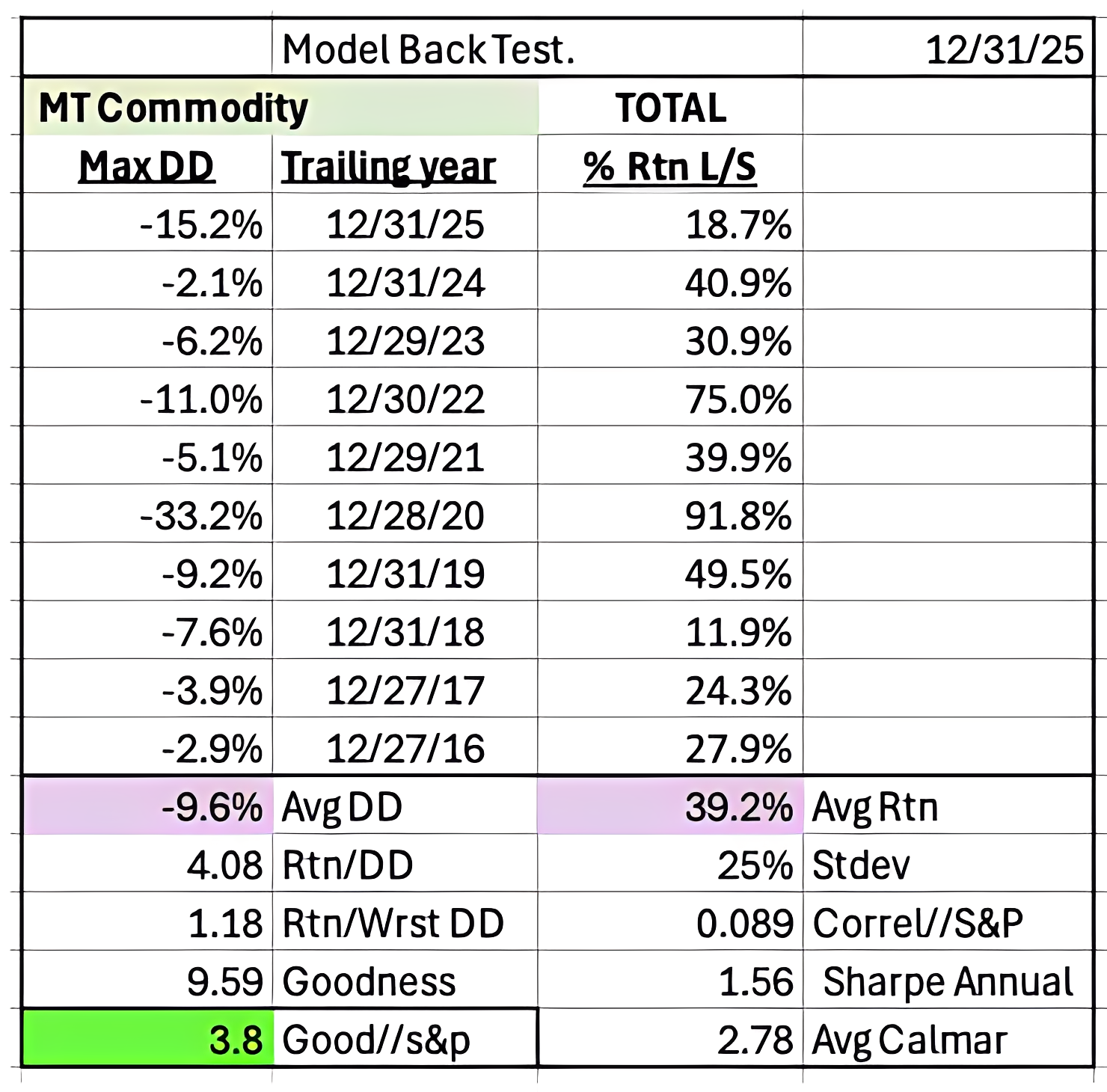
We have a mid-term model, with an average hold of 37 days, and moderate capacity. Our modeling and back-testing indicate that these commodities can be traded with an estimated risk-adjusted return of >3x holding the S&P and an average correlation to the S&P of 0.09 for the 10-year period shown.
Mid-Term Commodity Model Results
Hypothetical performance results have many inherent limitations. No representation is being made that any account will or is likely to achieve profits or losses similar to those shown. In fact, there are frequently sharp differences between hypothetical performance results and the actual results subsequently achieved by any particular trading program.